Newsletter Volume 10, Issue 4 December 2025
IPA Awards: Winning Innovation in Practice – Voices from the 2024 Outstanding Project
IPA Awards Committee
At ICPE2024, the IPA Outstanding Project Award recognized the Amsterdam Quay Walls Innovation Partnership for its exemplary use of press-in engineering in urban renewal. This award celebrates projects that combine technical excellence with societal impact—demonstrating how embedded wall systems can meet both functional and public expectations. Led by the City of Amsterdam, the initiative showcases how public authorities can drive sustainable infrastructure through innovative procurement and collaboration.

From Innovation Partnership to Practical Implementation
The City of Amsterdam adopted an Innovation Partnership framework to address the urgent challenge of ageing quay walls—chosen specifically to enable collaborative problem-solving beyond conventional procurement methods. This approach facilitated a transition from pilot success to full-scale implementation with market partners.
This section shows how the City applied this framework to tackle complex infrastructure challenges—in their own words below.
The following insights are shared by Martin van den Berg, Project Manager, Programme Bridges and Quay Walls, City of Amsterdam.
“Because Amsterdam faced a significant backlog in maintaining its quay walls, the city had a major challenge to bring this project to market in an innovative way. That context was precisely the reason why we chose the Innovation Partnership framework. It allowed us to collaborate closely with market parties and find new solutions.
G-Kracht, as a combined entity, successfully navigated all the necessary TRL (Technology Readiness Level) stages. They demonstrated that their technique met the City of Amsterdam’s conditions to carry out the work faster, more cost-effectively, and with significantly less disruption. The press-in technique ensured that the work could be done with minimal vibrations and with no noise. This brought substantial benefits to the surrounding environment.”
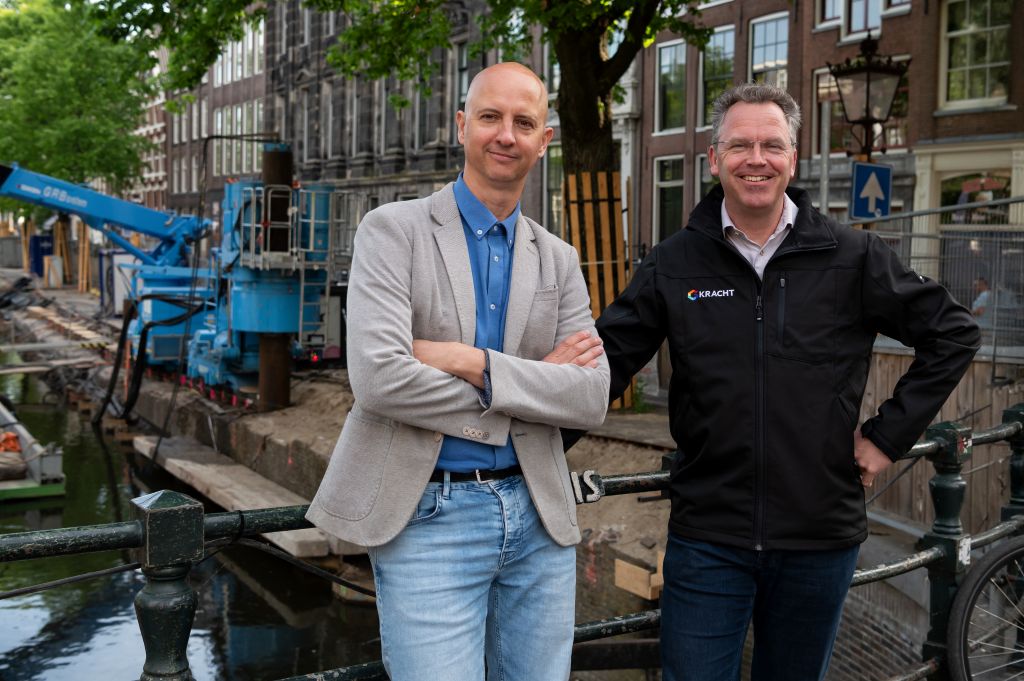
Martin van den Berg, Project Manager at the City of Amsterdam (left)
together with Edwin Boonstoppel, project manager at G-Kracht. (right)
Public Authority Perspective
Balancing infrastructure renewal with heritage preservation and public engagement was a central priority. Below, the City of Amsterdam shares how this balance was achieved in practice.
“When launching the Innovation Partnership, one of the city’s main priorities was to keep Amsterdam accessible, especially since this is one of the most visited and busiest areas of the city, while minimizing disruption as much as possible.
G-Kracht submitted an excellent plan that met the requirements of the City’s Monuments and Archaeology Department, which safeguards Amsterdam’s heritage. The G-Kracht technique ensures minimal use of both the waterway and the quay, allowing continued passage on the water and along the quay. By requiring very limited working space, their approach significantly reduces disturbance to the city and its residents.
From the very beginning, we closely involved the City’s Monuments and Archaeology Department to ensure that all works respected the historical value of the area. In addition, we actively engaged with local residents and businesses through information sessions and site visits, sharing updates and listening to their concerns. This open dialogue helped to build mutual understanding and trust, which was essential for working in such a sensitive and densely populated part of Amsterdam”
Environmental and Social Impact
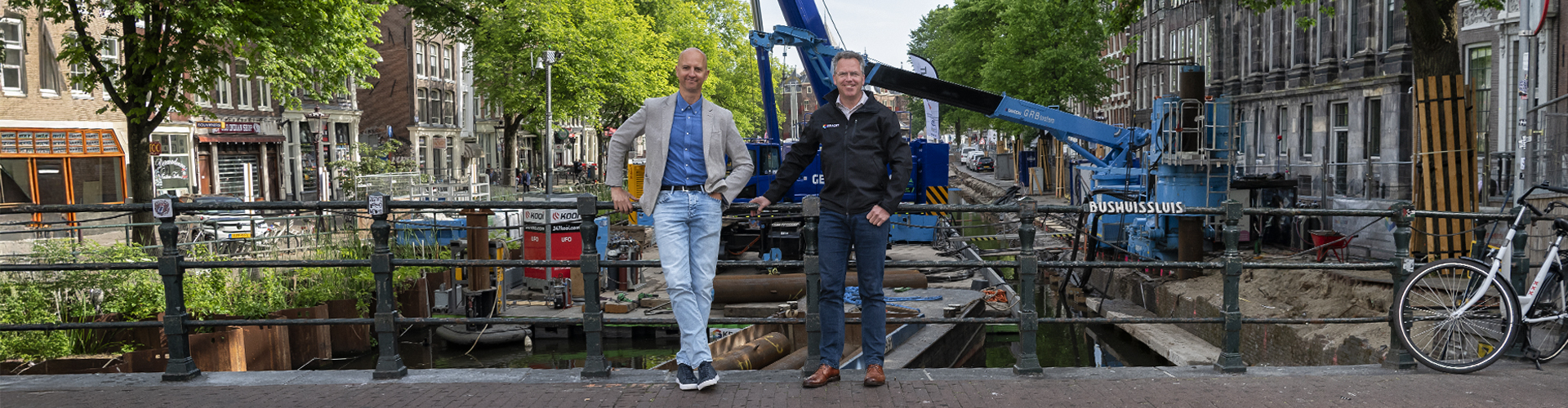
Sustainability was at the heart of the project. By using the Gyropress Method™ and fully electric equipment, the team minimized noise, vibration, and CO₂ emissions, delivering Amsterdam’s first electrically executed quay wall project. Here is how the City describes these environmental measures in practice:
“The project placed strong emphasis on minimizing environmental impact. The Gyropress Method from GIKEN LTD., used by G-Kracht, allows sheet piles to be installed without vibration and with very low noise levels, which is particularly valuable in the historic city centre. In addition, the method requires less heavy equipment and reduces transport movements, helping to lower CO₂ emissions. Moreover, GIKEN’s equipment is fully electric, which enables us to realize the first electrically executed quay wall project in Amsterdam, located at the Kloveniersburgwal. Together, these factors contribute to a more sustainable and socially responsible way of renewing Amsterdam’s quay walls.
Both local residents and internal staff from the City of Amsterdam have been extremely pleased with this method. One of the biggest advantages is that we can preserve trees in the centre of Amsterdam, something that was not possible before. As a short anecdote, while we were on site, a local resident stopped by and mentioned how pleased they were with the new method. They noted that it was remarkably quiet and that the work was progressing very quickly. It was great to see such positive, on-the-ground feedback from the community.”
 |
| City of Amsterdam project team together with Arjan Bot, site manager for G-Kracht at Kloveniersburgwal. De Waag—a historic former city gate—can be seen in the background. |
Collaboration and Stakeholder Engagement
The Innovation Partnership fostered openness and knowledge sharing among multiple consortia. Stakeholders were involved from the earliest stages, ensuring flexibility and transparency throughout the process. The City explains this approach in practice:
“We involved all stakeholders right from the very beginning, starting at the contract drafting stage. We wanted them to be open to radically innovative methods, which also required flexibility in certain project requirements along the way.
At the same time, these radical innovations offered clear benefits for all stakeholders — such as shorter construction times and reduced costs.
What made this contract form unique is that two other contractor combinations were also selected under the same tender procedure. Each consortium worked with its own technique, but they shared their experiences and lessons learned with one another at different locations across the city. This open exchange of knowledge and results created a collaborative environment in which all partners could learn and benefit together.
The Innovation Partnership (IPS) procurement procedure was based on functionally defined objectives and principles. Out of the sixteen parties that applied, three were selected to continue based on their Proposal of Approach. In their proposals, they not only described their technical solutions but also demonstrated how they would embody the spirit of “Partnership,” reflecting core values such as openness and continuous development. This Proposal of Approach serves as the foundation for the subsequent stages, in which the innovation is further developed, culminating in a pilot project as the final phase of the Research and Development stage.”

Phases of the Innovation Partnership (IPS) procurement process, from bidding to standardization.
Reflections on Receiving the IPA Outstanding Project Award
The following reflections are shared by the City of Amsterdam on receiving the award:
“Winning the IPA Outstanding Project Award is a great honor for the City of Amsterdam. It recognizes not only the innovative technology developed by GIKEN and implemented through G-Kracht, but also the strong collaboration between the city, its partners, and the wider market.
For us, this award symbolizes the success of a new way of working—one that combines innovation, sustainability, and respect for the city’s heritage. It also reinforces our belief that open partnerships with the market can lead to groundbreaking solutions for complex urban challenges such as the renewal of Amsterdam’s quay walls.
This recognition has been very motivating for everyone involved. It confirmed that our joint efforts to work in a more innovative and collaborative way are being noticed internationally.
For the project team, it reinforced our sense of pride and commitment to continue exploring new approaches that make a real difference for the city and its residents.
It has also strengthened the confidence of our stakeholders, both within the municipality and among our partners, that investing in innovation and partnership truly delivers tangible results.”
Future Outlook
The City of Amsterdam shares its plans for the future:
“With this procurement, we will be working together with G-Kracht over the next eight years to realize quay walls in Amsterdam’s city centre.
We are currently setting up a programme so they can complete these projects in a logical sequence. In addition, the IPS procurement procedure will be used more often in the city, for example, for a programme involving sports fields in Amsterdam.”
Message to the IPA Community
The City of Amsterdam shares its appreciation and vision with the IPA community:
“We would like to express our appreciation to GIKEN, G-Kracht, and the International Press-in Association for their continued commitment to innovation and collaboration. The press-in method shows that it is possible to work more sustainably, quietly, and respectfully within complex urban environments like Amsterdam’s historic city centre.
We believe that the spirit of partnership, sharing knowledge, embracing new ideas, and learning together is essential for tackling the infrastructure challenges of the future.
We look forward to continuing this journey together and to seeing how the global press-in community will keep pushing the boundaries of what is possible.
As project manager for the Bridges and Quay Walls programme, I’m proud to contribute to this pioneering collaboration that combines technical innovation with respect for the city and its people.”
Looking Ahead
Why this matters: As cities worldwide face ageing infrastructure and climate challenges, Amsterdam’s approach offers a model for sustainable renewal. The IPA hopes this case will inspire other cities and engineering teams to explore similar innovations.
Visual Highlights
Watch the press-in piling system in action along Amsterdam’s historic canals:
Related Article (Dutch)
Learn more about Amsterdam’s Innovation Partnership approach:
Further Information
- Outstanding Project Award details and nomination form: https://www.press-in.org/en/page/award
- Contact: ipa.award@press-in.org