
Newsletter Volume 10, Issue 4 December 2025
Young Members
Sustainability and Innovation in Civil Works: Example of Amsterdam Quay Wall Rehabilitation Project
Sustainability and Innovation in Civil Works: Example of Amsterdam Quay Wall Rehabilitation Project
Yahya Ndoye “Sidi”
Technical Advisor, GIKEN Europe B.V
Technical Advisor, GIKEN Europe B.V
 I'm Sidi, a Technical Advisor at GIKEN Europe B.V. since January 2023, based in the Netherlands. I previously worked for GIKEN Ltd. in Japan for three years on projects funded by JICA (Japan International Cooperation Agency) under ODA schemes in Asia and Africa. I also completed my master’s degree in Japan at Saitama University, through the International Graduate Program in Civil and Environmental Engineering. This paper describes the ongoing rehabilitation project of the Amsterdam quay wall at Kloveniersburgwal. The city of Amsterdam alone has over 600 km of quay walls and around 1,600 bridges. Of these, approximately 200 km are constructed of masonry supported by wooden pile foundations (R. Voortman, 2021). Over time, the loads on these structures have steadily increased, and combined with the degradation of the wooden piles, this has led to the collapse of part of a quay in 2019. Emergency measures included cutting down trees, restricting access to heavy machinery, and installing temporary sheet pile walls to stabilize the structures.
The rehabilitation of the structure is a complex operation, as it requires, in some areas, closing parts of the city, halting traffic, and managing noise disturbances and machine vibrations, which can damage existing infrastructure. In addition, houseboats will need to be relocated, and most of the trees will be felled. To overcome these challenges, the city of Amsterdam launched a special program in 2020, known as an "Innovation Partnership," to seek highly advanced technical solutions. Thus, G-Kracht, a joint-venture company comprising GIKEN Europe B.V., and the Dutch firms Gebr. De Koning B.V. and Van Gelder B.V. received the highest evaluation among the 16 groups that submitted bids for the tender.
The G-Kracht team proposed an innovative approach using a technology called the Gyropress Method™, a fully electric machine developed by GIKEN LTD. This construction method helped minimize disruptions while speeding up the work, eliminating the need to cut down trees thanks to the construction method known as the GRB System™ (GIKEN Reaction Base).
Following a successful test phase in 2023 at Singel Amsterdam, G-Kracht initiated the first rack of the commercial phase around April 2025. The project has continued up to date, with nearly 164 piles being installed as of August 2025. The project aligns with carbon neutrality; all working machines, from the service crane to the GYRO PILER™, etc., are fully electric. The trees along the quay wall have been saved using the CLAMP CRANE™ CB2-11. With the GYRO PILER, the tubular piles are pressed and rotated directly into the existing masonry quay wall; thus, the new piles replace the old quay wall, which starts functioning immediately.
For more information about this project, please contact GIKEN Europe B.V., at info@giken.nl
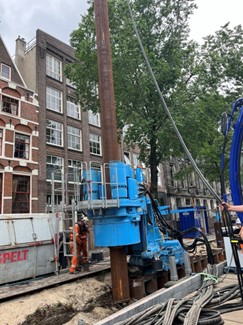
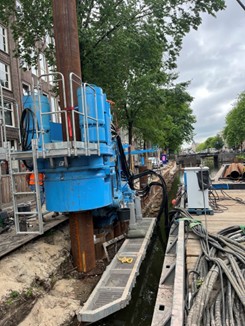
Fig. 1 The GYRO PILER GRV0611e (SP16) installing 508 mm tubular piles directly to the existing masonry quay wall
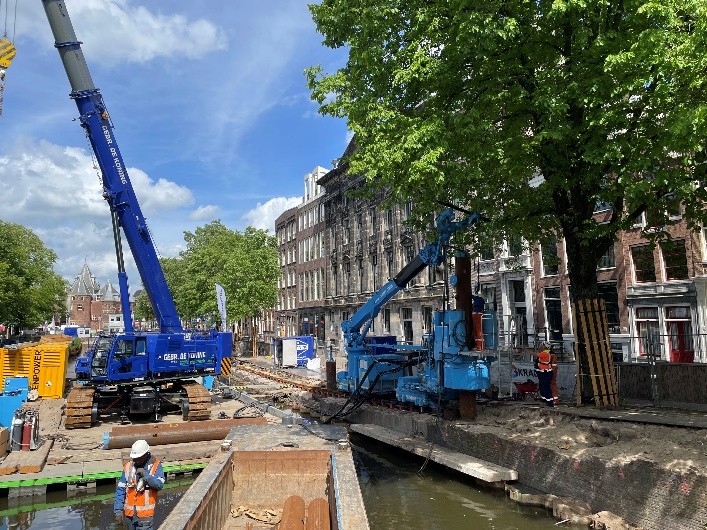
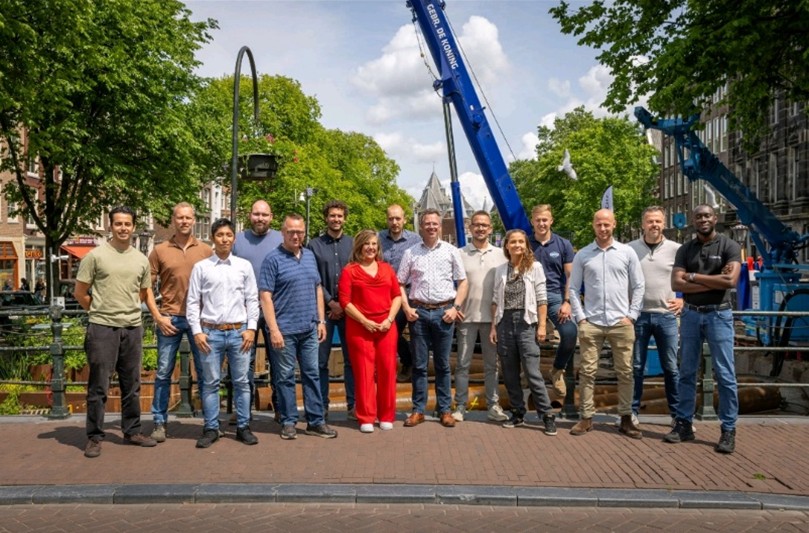
Fig. 2 (a) Piling under the tree using CLAMP CRANE CB2-11, and (b) G-Kracht members
[1] R. Voortman (2021). The Historic Quay Walls of Amsterdam: A study into the hidden structural capacity of masonry quay walls under the condition of a partly failing foundation.
[2] Korff, M., Hemel, M. J., & Peters, D. J. (2022). Collapse of the Grimburgwal, a historic quay in Amster-dam, the Netherlands. Proceedings of the Institution of Civil Engineers: Forensic Engineering, 175(4), 96-105. Article 2100018. https://doi.org/10.1680/jfoen.21.00018
[3] GIKEN Website, G-KRACHT, Municipality of Amsterdam
| << Previous | Newsletter Top | Next >> |