
Newsletter Volume 11, Issue 1 March 2026
Special Contribution
Soft Soil Treatment Solutions for High-Speed Railway Embankments in Vietnam: Insights from Physical Model Tests
Soft Soil Treatment Solutions for High-Speed Railway Embankments in Vietnam: Insights from Physical Model Tests
Nguyen Chau Lan1, Tran Van Thuan1, Vu Anh Tuan2
1University of Transport and Communication, Vietnam
2Le Quy Don Technical University, Vietnam
2Le Quy Don Technical University, Vietnam
1. Introduction
The Vietnamese government has recently proposed an ambitious high-speed railway connecting key cities, including Hanoi and Ho Chi Minh City, over a modern rail network (Bui Tien, Nguyen Chau, & Tengfei, 2025; Hang, Thang, Hung, & Hoa, 2021; Thach, 2024). Vietnam's railway infrastructure has historically relied on conventional narrow-gauge tracks, which have constrained train velocities and overall capacity. The shift to high-speed rail necessitates significant investment in subgrade stabilization methods, material enhancements, and the treatment of soft soils. Furthermore, Vietnam must confront distinct environmental challenges, such as increased precipitation, recurring flooding, and soft soil conditions, which may impact track stability.According to the Pre-Feasibility Study Report for the North-South High-Speed Railway project, the long route traverses’ regions with highly variable soil and rock types, stratigraphic structures, and geological conditions. As a result, the design and construction of the roadbed require careful technical consideration. The pre-feasibility study report for the North-South high-speed railway (HSR) project indicates that the roadbed structure accounts for 449 km, representing 30% of the total structure, including road embankment, tunnels, and bridges.
This paper presents the geological conditions of North-South HSR, summarizes applicable ground improvement solutions for HSR embankments, and investigates the dynamic behavior of a geogrid-reinforced pile-supported (GRPS) embankment through physical model testing under simulated high-speed train loading.
2. Geological Conditions of the North-South High-Speed Railway
According to the geological survey report for the high-speed railway conducted by JICA in 2013 (Fig. 1), along the Hanoi-Ninh Binh route, the geological survey results indicate very soft clay layers over 10m thick from Ngoc Hoi to Nam Dinh via Phu Ly, and from Nam Dinh to Ninh Binh. In Vinh City, the surface alluvial clay layers are also classified as "soft clay" with NSPT value <4; high moisture content, void ratio> 0.8. Consolidation coefficient Cc can be expressed as Cc = -0.2661 + 0.01253・LL(%) (Cc = 0.2-0.6), consolidation coefficient Cv = 0.827 × 10⁻³ cm²/s (JICA, 2013).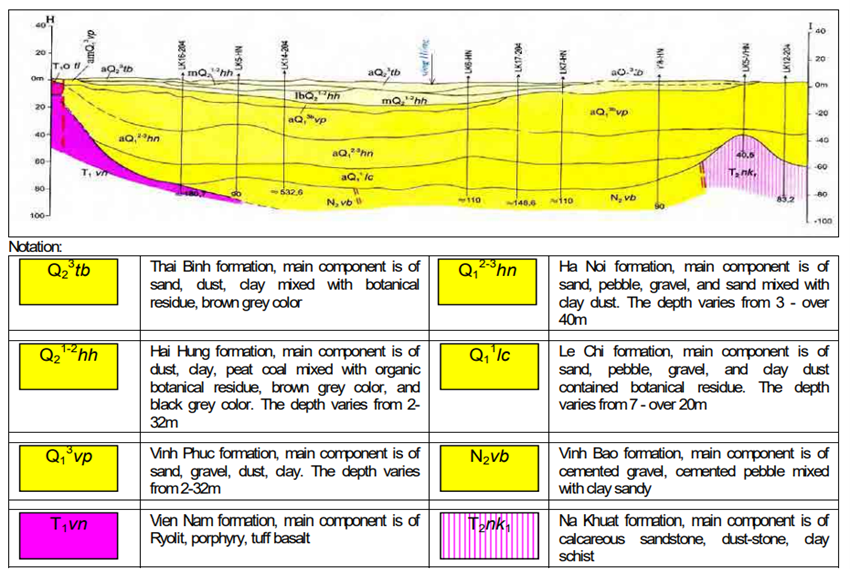 |
| Fig. 1. Geological cross-section of the Hanoi area (JICA-2013 survey report) (JICA, 2013) |
In the case of a 6m-high embankment, the untreated settlement of the HSR embankment may reach up to 2 m in the Ninh Binh and Thanh Hoa areas, and the time required for consolidation is very long (>50 years) without treatment. Therefore, HSR lines passing through this area will require ground improvement to meet the stringent deformation requirements outlined in HSR standards.
3. HSR subgrade design
The design concept has recently shifted from a strength-based to a deformation-based approach. According to HSR standard requirements, for ballasted tracks with a speed range of 200-300 km/h, the permissible post-construction settlement (PCS) is 5~10 cm; at transition zones, PCS is 3~5 cm with a controlled settlement rate of 3 cm/year. In the case of embankments using reinforced concrete slab tracks, the permissible PCS is required to be 1.5~3 cm; differential settlement is 0.5 cm, and the rotation angle is ≤1/1000 (Bui Tien et al., 2025; Duan, Wu, Bian, & Jiang, 2022; Wang, Luo, Liu, Liu, & Xie, 2020; Zhang, Dias, Jenck, & Briançon, 2024; Zhou, Wang, & Shan, 2020; Zufarihsan, Tambusay, Suprobo, Suryanto, & Laghrouche, 2025).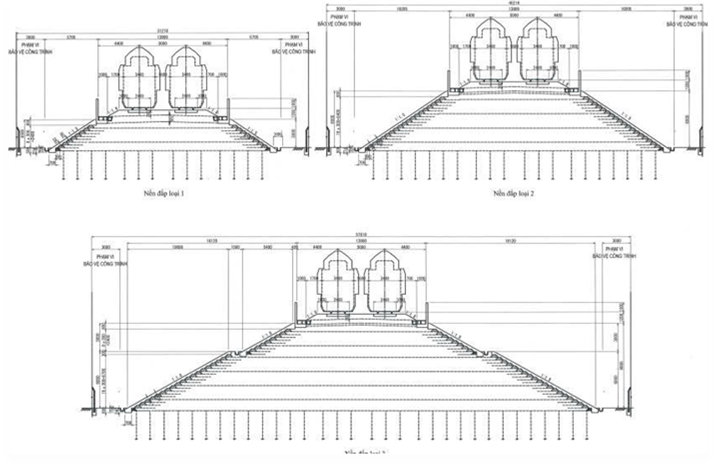 |
| Fig. 2. Cross-section of HSR embankment in North-South HSR |
According to the typical cross-section of the embankment for the North-South HSR line, the embankment height is substantial (Fig. 2), as it passes through areas with significant variations in geological conditions, including thickness and physico-mechanical properties, especially in the Red River Delta region, where a thick layer of soft soil is present. Therefore, the embankment treatment solution will play a crucial role in ensuring the project's technical and economic viability. Simultaneously, the embankment treatment solution needs to be systematically studied, considering both static and dynamic loads, as well as the influence of train speed. However, in-depth studies on the application of these solutions to high-speed railway embankments in Vietnam remain limited, particularly regarding design guidance, field observations, and long-term performance evaluation.
4. Settlement control for HSR embankment
Typically, soft soils are characterized by high water content, high permeability, high compressibility, and low shear strength, which pose challenges to the stability of railway foundations. Without proper design, cyclic train loading can lead to significant subgrade settlement. The train load is transmitted from the tracks through sleepers and slabs to the foundation, with its magnitude influenced by train weight, traffic volume, and speed. Therefore, effective settlement control is crucial to maintaining the stability and safety of high-speed railway operations on soft subgrade ground (Hao, Miao, Fang, Wang, & Shu, 2024; Huang, Su, Liu, & Wang, 2015; Kim & Kim, 2021; Lin et al., 2025; Liu et al., 2024; Suyal & Krishna Maheshwari, 2024).
Therefore, the primary objectives of ground improvement techniques are to reduce settlement and enhance shear strength, particularly when natural ground conditions fail to satisfy stability or deformation control requirements.
Previous research has shown that solutions for soft soil treatment of HSR embankments in China, Japan, and Europe vary according to geological conditions and design philosophies. However, the pile foundation combined with geogrid is widely used for treating soft soil (Bui Tien et al., 2025; Cheng, Cai, Zha, Zhou, & Gong, 2022; Zhou et al., 2020; Zufarihsan et al., 2025).
China
Thus, the general trend worldwide, as well as in some upcoming projects in Vietnam, is to apply piles combined with geogrids or pile raft foundations for railway embankments on soft soil to meet the required settlement requirements.
To evaluate the effectiveness of the GRPS system for HSR embankments, we conducted laboratory physical model tests to simulate the actual working conditions of HSR embankments under dynamic loading.
The experimental prototype is based on a section of the North-South HSR line near Thu Thiem Station. According to the JICA Study Team report (JICA, 2013), the geological conditions in the Thu Thiem area comprise a very soft fat clay layer (0-2.91 m thick), underlain by a soft lean clay layer (2.91 m-19.7 m thick), and a clayey sand layer at the bottom (19.7 m-75 m thick), as shown in Fig. 3.
The embankment utilizes a GRPS system. The embankment height is 6.0 m, with side slopes of 1:1.5. The piles are 20 m long, 0.6 m in diameter, and spaced 3.0 m center-to-center in a square arrangement. Pile caps are 1.0 m square and 0.4 m thick. A 10 cm thick layer of 1x2 crushed stone forms a load transfer platform (LTP) above the pile caps, with one layer of geosynthetic reinforcement placed within it (Fig. 3). For the physical model, a similarity law was applied with a scale of 1:40.
Piles:
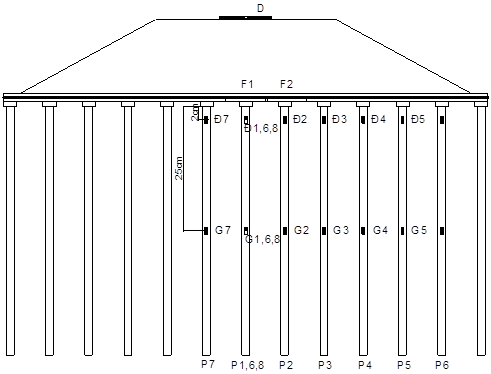
Model piles were fabricated from aluminum alloy (Elastic Modulus = 70 GPa) at a geometric scale of 1:40. Each model pile was 0.5 m long, with an outer diameter of 15 mm and an inner diameter of 11 mm. A pile cap made of aluminum alloy was attached to the top of the pile. A total of 117 test piles were fabricated, including eight instrumented piles. Each instrumented pile had two strain gauge measurement points: one near the top (20 mm below the cap) and one at the mid-height of the shaft (Fig. 4 and Fig. 5).
Therefore, the primary objectives of ground improvement techniques are to reduce settlement and enhance shear strength, particularly when natural ground conditions fail to satisfy stability or deformation control requirements.
Previous research has shown that solutions for soft soil treatment of HSR embankments in China, Japan, and Europe vary according to geological conditions and design philosophies. However, the pile foundation combined with geogrid is widely used for treating soft soil (Bui Tien et al., 2025; Cheng, Cai, Zha, Zhou, & Gong, 2022; Zhou et al., 2020; Zufarihsan et al., 2025).
China
- Geotechnical pile-grid system often called a Geosynthetic-Reinforced Pile-Supported system (GRPS): Successful in Beijing-Shanghai, settlement 3-10 mm, modulus ≥50 MPa, suitable for soft clay soils of the Yangtze Delta (Cu = 10-30 kPa, soft soil depth from 10-30 m).
- Pile-raft foundation: Highly stable in Beijing-Tianjin HSR Line, settlement limit is 3-10 mm, using CFG with a diameter of 0.4-0.6 m.
- Japan (Shinkansen): Raft-pile foundation, differential settlement <10 mm/10 m, concrete piles with a diameter of 0.5-1.0 m.
- France (TGV): Full concrete piles, settlement <10 mm, applied to locations near bridges/stations.
- Germany (ICE): Stone piles combined with raft-pile foundation, settlement 20-30 mm.
Thus, the general trend worldwide, as well as in some upcoming projects in Vietnam, is to apply piles combined with geogrids or pile raft foundations for railway embankments on soft soil to meet the required settlement requirements.
5. Physical model test for HSR embankment in soft soil in Vietnam
5.1. Physical model testTo evaluate the effectiveness of the GRPS system for HSR embankments, we conducted laboratory physical model tests to simulate the actual working conditions of HSR embankments under dynamic loading.
The experimental prototype is based on a section of the North-South HSR line near Thu Thiem Station. According to the JICA Study Team report (JICA, 2013), the geological conditions in the Thu Thiem area comprise a very soft fat clay layer (0-2.91 m thick), underlain by a soft lean clay layer (2.91 m-19.7 m thick), and a clayey sand layer at the bottom (19.7 m-75 m thick), as shown in Fig. 3.
The embankment utilizes a GRPS system. The embankment height is 6.0 m, with side slopes of 1:1.5. The piles are 20 m long, 0.6 m in diameter, and spaced 3.0 m center-to-center in a square arrangement. Pile caps are 1.0 m square and 0.4 m thick. A 10 cm thick layer of 1x2 crushed stone forms a load transfer platform (LTP) above the pile caps, with one layer of geosynthetic reinforcement placed within it (Fig. 3). For the physical model, a similarity law was applied with a scale of 1:40.
Piles:
Model piles were fabricated from aluminum alloy (Elastic Modulus = 70 GPa) at a geometric scale of 1:40. Each model pile was 0.5 m long, with an outer diameter of 15 mm and an inner diameter of 11 mm. A pile cap made of aluminum alloy was attached to the top of the pile. A total of 117 test piles were fabricated, including eight instrumented piles. Each instrumented pile had two strain gauge measurement points: one near the top (20 mm below the cap) and one at the mid-height of the shaft (Fig. 4 and Fig. 5).
 |
| Fig. 3. Cross-section of HSR embankment at Thu Thiem station |
 |
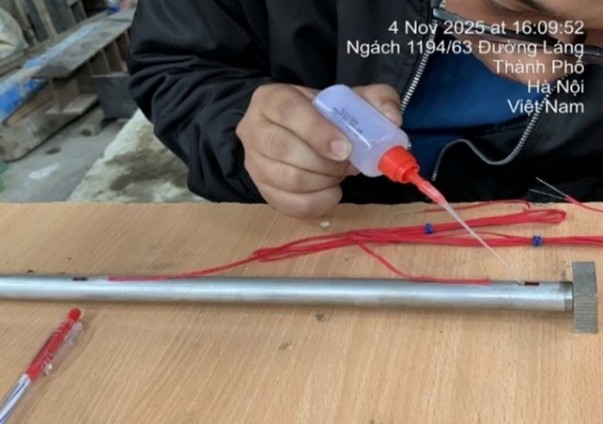 |
| Fig. 4. Position of the strain gages and other measurements for the physical model test | Fig. 5. Installation of a strain gage in pile for the physical model test |
Geogrid:
In this test, a Tensar InterAx NX geogrid, compatible with the crushed stone fill, was selected for the model test (Fig. 5). To simulate the soil-geogrid interaction characteristics, adhesive was applied to the geogrid surface, and sand was sprinkled on it to provide the appropriate frictional properties.
 |
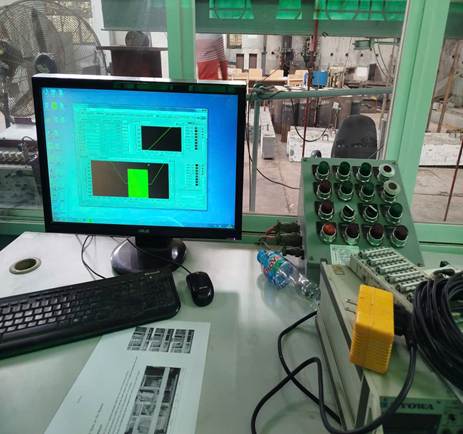 |
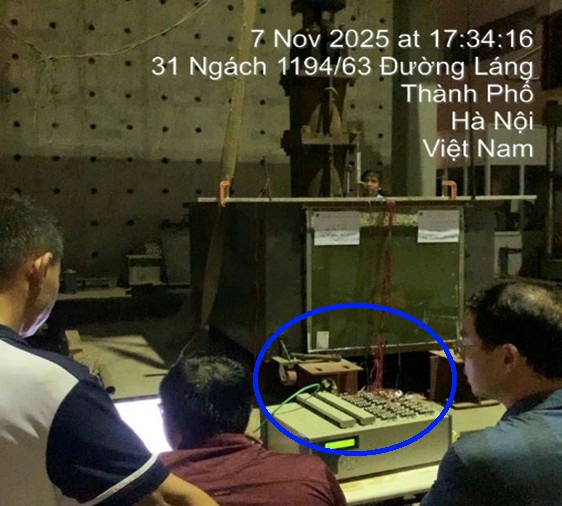
| Fig. 6. Data logger | Fig. 7. Cyclic control program |
Measurement
To measure earth pressure, four TML (Japan) earth pressure cells were installed, and to measure geogrid strain, four KYOWA (Japan) strain gauges were attached to the geogrid. A Ucam data acquisition system (Kyowa, Japan) was used to record all measurement data (Fig. 6). An Anco (USA) dynamic loading actuator with a loading frequency of 5 Hz was used to apply the cyclic load (Fig. 7).
Testing Procedure
To simulate the dynamic stress transferred from the train to the embankment surface, an empirical design formula was used. Assuming an operational speed of 350 km/h and an axle load of 22.5 tons, the calculated dynamic stress on the embankment surface is 140.4 kPa. Using a loading plate of 40 cm x 40 cm, the required peak dynamic load is 22.5 kN, applied at a frequency of 5 Hz (Fig. 7).
5.2. Results of physical model test
The results show that settlement increases rapidly in the initial stage and gradually approaches a stable state with a large number of cycles (Fig. 8). Specifically, in the first 0–10,000 cycles, settlement increases sharply from 0 to approximately 1.4 mm, reflecting the intense initial deformation that occurs due to soil structure rearrangement under cyclic loading. Between 10,000 and 20,000 cycles, the rate of settlement increases decreases significantly; the curve becomes flatter, with settlement reaching approximately 1.7–1.8 mm. As cycles continue to 45,000, settlement increases only very slightly, nearly stabilizing at a maximum value of approximately 2.0 mm, indicating that the composite structure and subsoil have reached a stable long-term working state under cyclic loading. This trend confirms that cumulative deformation primarily occurs during the initial loading stage, whereas the contribution of long-term cyclic loading to additional settlement is limited.
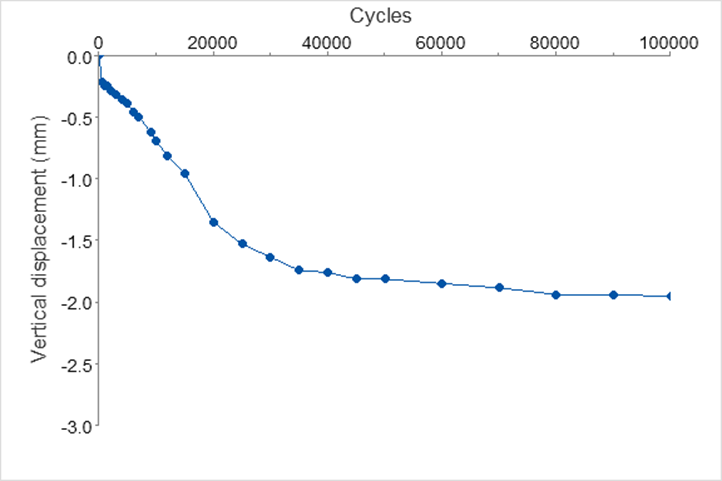 |
| Fig. 8. Cumulative settlement of the pile-net composite embankment |
The experimental results show that the variation of internal forces in the piles with the number of load cycles clearly reflects the interaction mechanism among components in the GRPS system (Fig. 9). In the initial stage (below 5,000 cycles), internal forces at observation points tend to increase sharply, indicating the process of soil particle rearrangement and the formation of the arching effect, which transfers load from the soil to the stiffer pile system. The rate of increase in internal forces gradually decreases, reaching a stable dynamic equilibrium after approximately 45,000 cycles, with internal force values remaining almost constant until the end of the test (100,000 cycles). Notably, the highest internal force concentration occurs at the head of the central pile (TP1), with a value of approximately 500 N, exceeding those at mid-pile positions (MP) and neighboring piles. This reflects the mechanism of direct and concentrated stress transfer at the pile head located directly beneath the loaded area.
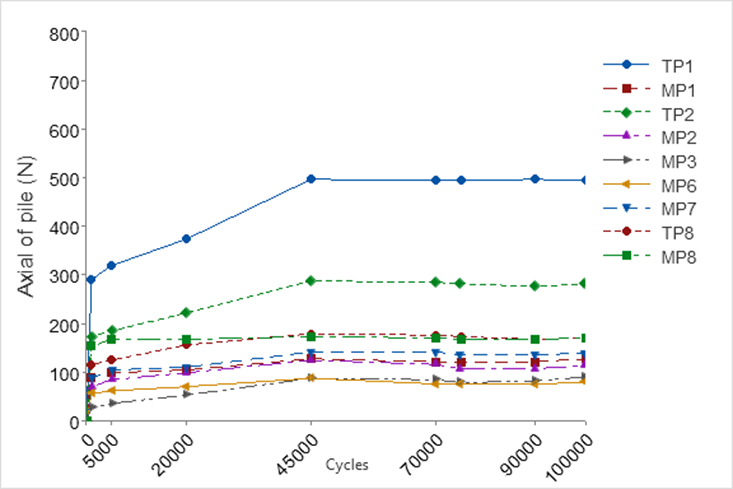 |
| Fig. 9. Axial force in pile shafts versus number of load cycles |
6. Conclusions
Currently, further research and standards are needed to enhance the use of pile systems for HSR embankments in soft soil.
The use of pile-grid structures and pile raft foundations addresses the deformation issue for HSR embankments in soft soil.
Regarding the physical model, the model results allow for the calculation of the influence of dynamic loads acting on the HSR embankment. The performance efficiency of applying the grid-pile structure under Vietnamese conditions can be analyzed. The results show that the stabilization of internal force characteristics in the later stage confirms the sustainable load-bearing capacity of the GRPS solution, ensuring requirements for strength and stability under long-term dynamic loading for high-speed railways.
The use of pile-grid structures and pile raft foundations addresses the deformation issue for HSR embankments in soft soil.
Regarding the physical model, the model results allow for the calculation of the influence of dynamic loads acting on the HSR embankment. The performance efficiency of applying the grid-pile structure under Vietnamese conditions can be analyzed. The results show that the stabilization of internal force characteristics in the later stage confirms the sustainable load-bearing capacity of the GRPS solution, ensuring requirements for strength and stability under long-term dynamic loading for high-speed railways.
References
Bui Tien, T., Nguyen Chau, L., & Tengfei, W. (2025). Overview of advances and practices in high-speed railway earth structures in China. Transport and Communications Science Journal, 76(2025), 405-419. doi:10.47869/tcsj.76.2025.4
Cheng, X., Cai, X., Zha, W., Zhou, Y., & Gong, L. (2022). Engineering characteristics test on pile–net composite foundation in loess areas. 175(1), 3-14. doi:10.1680/jgeen.20.00042
Duan, X., Wu, Y., Bian, X., & Jiang, J. (2022, 2022//). Dynamic Behaviors of Piled Embankment Under High-Speed Train Loads. Paper presented at the Advances in Transportation Geotechnics IV, Cham.
Hang, N. T. N., Thang, P. B., Hung, T. V., & Hoa, P. D. (2021). Research on the dynamic response of high-speed railway bridges. Journal of Science and Technology in Civil Engineering (JSTCE) - HUCE (in Vietnamese), 15(7V), 1-12. doi:10.31814/stce.huce(nuce)2021-15(7V)-01
Hao, D., Miao, C., Fang, S., Wang, X., & Shu, Q. (2024). Experimental and Numerical Study on Lightweight-Foamed-Concrete-Filled Widened Embankment of High-Speed Railway. Materials (Basel), 17(18). doi:10.3390/ma17184642
Huang, J., Su, Q., Liu, T., & Wang, X. (2015). Vibration and Long-Term Performance Analysis of Pile-Plank-Supported Low Subgrade of Ballastless Track under Excitation Loads. Shock and Vibration, 2015, 1-12. doi:10.1155/2015/404627
JICA. (2013). Study for the formulation of high speed railway projects on Hanoi – Vinh and Ho Chi Minh – Nha Trang section: Geological survey and preparation of topographic map.
Kim, U., & Kim, D. S. (2021). Evaluation of Deformation Characteristic of Railway Subgrade Using Reinforced Rigid Walls with Short Reinforcement under Repetitive and Static Loads. Applied Sciences, 11(8). doi:10.3390/app11083615
Lin, W.-K., Mao, B., Duan, B., Tang, X.-W., Pan, X.-D., Xue, H.-C., . . . Shan, Y. (2025). Numerical Analysis of Pile‐Supported Reinforced Embankments in Deep Soft Soil Regions Based on Soft Soil Creep Parameter Optimization. Advances in Civil Engineering, 2025(1). doi:10.1155/adce/1759641
Liu, J., Zhou, W., Cao, J., Li, X., Jin, Y., Ye, Q., & Feng, G. (2024). Dynamic performance of a slab track-concrete box subgrade under a double-line high speed railway. PLoS One, 19(12), e0311969. doi:10.1371/journal.pone.0311969
Suyal, T., & Krishna Maheshwari, B. (2024). Railway induced ground vibrations in soft soil. Japanese Geotechnical Society Special Publication, 10(35), 1353-1358. doi:10.3208/jgssp.v10.OS-24-07
Thach, P. N. (2024). The effect of train speed on railway track vibration due to high-speed train load Transport and Communications Science Journal (In Vietnamese), 75(5), 1775-1788.
Wang, T., Luo, Q., Liu, J., Liu, G., & Xie, H. (2020). Method for slab track substructure design at a speed of 400 km/h. Transportation Geotechnics, 24. doi:10.1016/j.trgeo.2020.100391
Zhang, J., Dias, D., Jenck, O., & Briançon, L. (2024). 3D Numerical Analysis of a Geogrid-Reinforced Piled Embankment: High-Speed Railway. 24(11), 04024241. doi:doi:10.1061/IJGNAI.GMENG-8106
Zhou, S., Wang, B., & Shan, Y. (2020). Review of research on high-speed railway subgrade settlement in soft soil area. Railway Engineering Science, 28(2), 129-145. doi:10.1007/s40534-020-00214-x
Zufarihsan, R., Tambusay, A., Suprobo, P., Suryanto, B., & Laghrouche, O. (2025). Recent developments in high-speed railway in Indonesia: Superstructure construction and track infrastructure. Transportation Research Interdisciplinary Perspectives, 31. doi:10.1016/j.trip.2025.101385
Bui Tien, T., Nguyen Chau, L., & Tengfei, W. (2025). Overview of advances and practices in high-speed railway earth structures in China. Transport and Communications Science Journal, 76(2025), 405-419. doi:10.47869/tcsj.76.2025.4
Cheng, X., Cai, X., Zha, W., Zhou, Y., & Gong, L. (2022). Engineering characteristics test on pile–net composite foundation in loess areas. 175(1), 3-14. doi:10.1680/jgeen.20.00042
Duan, X., Wu, Y., Bian, X., & Jiang, J. (2022, 2022//). Dynamic Behaviors of Piled Embankment Under High-Speed Train Loads. Paper presented at the Advances in Transportation Geotechnics IV, Cham.
Hang, N. T. N., Thang, P. B., Hung, T. V., & Hoa, P. D. (2021). Research on the dynamic response of high-speed railway bridges. Journal of Science and Technology in Civil Engineering (JSTCE) - HUCE (in Vietnamese), 15(7V), 1-12. doi:10.31814/stce.huce(nuce)2021-15(7V)-01
Hao, D., Miao, C., Fang, S., Wang, X., & Shu, Q. (2024). Experimental and Numerical Study on Lightweight-Foamed-Concrete-Filled Widened Embankment of High-Speed Railway. Materials (Basel), 17(18). doi:10.3390/ma17184642
Huang, J., Su, Q., Liu, T., & Wang, X. (2015). Vibration and Long-Term Performance Analysis of Pile-Plank-Supported Low Subgrade of Ballastless Track under Excitation Loads. Shock and Vibration, 2015, 1-12. doi:10.1155/2015/404627
JICA. (2013). Study for the formulation of high speed railway projects on Hanoi – Vinh and Ho Chi Minh – Nha Trang section: Geological survey and preparation of topographic map.
Kim, U., & Kim, D. S. (2021). Evaluation of Deformation Characteristic of Railway Subgrade Using Reinforced Rigid Walls with Short Reinforcement under Repetitive and Static Loads. Applied Sciences, 11(8). doi:10.3390/app11083615
Lin, W.-K., Mao, B., Duan, B., Tang, X.-W., Pan, X.-D., Xue, H.-C., . . . Shan, Y. (2025). Numerical Analysis of Pile‐Supported Reinforced Embankments in Deep Soft Soil Regions Based on Soft Soil Creep Parameter Optimization. Advances in Civil Engineering, 2025(1). doi:10.1155/adce/1759641
Liu, J., Zhou, W., Cao, J., Li, X., Jin, Y., Ye, Q., & Feng, G. (2024). Dynamic performance of a slab track-concrete box subgrade under a double-line high speed railway. PLoS One, 19(12), e0311969. doi:10.1371/journal.pone.0311969
Suyal, T., & Krishna Maheshwari, B. (2024). Railway induced ground vibrations in soft soil. Japanese Geotechnical Society Special Publication, 10(35), 1353-1358. doi:10.3208/jgssp.v10.OS-24-07
Thach, P. N. (2024). The effect of train speed on railway track vibration due to high-speed train load Transport and Communications Science Journal (In Vietnamese), 75(5), 1775-1788.
Wang, T., Luo, Q., Liu, J., Liu, G., & Xie, H. (2020). Method for slab track substructure design at a speed of 400 km/h. Transportation Geotechnics, 24. doi:10.1016/j.trgeo.2020.100391
Zhang, J., Dias, D., Jenck, O., & Briançon, L. (2024). 3D Numerical Analysis of a Geogrid-Reinforced Piled Embankment: High-Speed Railway. 24(11), 04024241. doi:doi:10.1061/IJGNAI.GMENG-8106
Zhou, S., Wang, B., & Shan, Y. (2020). Review of research on high-speed railway subgrade settlement in soft soil area. Railway Engineering Science, 28(2), 129-145. doi:10.1007/s40534-020-00214-x
Zufarihsan, R., Tambusay, A., Suprobo, P., Suryanto, B., & Laghrouche, O. (2025). Recent developments in high-speed railway in Indonesia: Superstructure construction and track infrastructure. Transportation Research Interdisciplinary Perspectives, 31. doi:10.1016/j.trip.2025.101385
A brief CV of Dr. Nguyen Chau Lan
 |
Dr. Lan is chair of the Geotechnical Engineering Department, Civil Engineering Faculty of the University of Transport and Communications, Vietnam. He obtained a Ph.D. from the Infrastructure Environmental Engineering Lab at Kyoto University in 2013. Currently, he focuses on geotechnical aspects of waste landfills, soil improvement, landslides, and rail embankments. |
A brief CV of MSc. Tran Van Thuan
 |
MSc. Tran Van Thuan is currently a lecturer at University of Transport and Communications (UTC), Vietnam. He obtained both his Bachelor’s degree in Engineering and Master’s degree from the same university, UTC. At present, he is pursuing a PhD in Traffic Construction Engineering at the UTC. His main research interests focus on foundation engineering in transportation construction, particularly subgrade and foundation systems for high-speed railways. |
A brief CV of Assoc. Prof. Vu Anh Tuan
 |
Assoc. Prof. Vu Anh Tuan received his Bachelor’s degree from University of Transport and Communication, Vietnam, his Master’s degree from Le Quy Don Technical University, Vietnam, and his Ph.D. degree from Kanazawa University, Japan. He is currently a Senior Lecturer at Le Quy Don Technical University and serves as Director of the International Press-in Association (IPA). He is also an Executive Committee Member of the Vietnamese Society of Soil Mechanics and Geotechnical Engineering (VSSMGE), Head of the Member Development Board of VSSMGE, and a member of the International Society of Soil Mechanics and Geotechnical Engineering (ISSMGE). His research interests focus on geotechnical engineering, particularly pile foundation engineering and the mechanical behavior of soil and granular materials. |
| << Previous | Newsletter Top | Next >> |