
Newsletter Volume 11, Issue 1 March 2026
Young Members
Investigating the Potential of Municipal Solid Waste Incinerator (MSWI) Bottom Ash as Sustainable Embankment Fill in Northern Vietnam
Investigating the Potential of Municipal Solid Waste Incinerator (MSWI) Bottom Ash as Sustainable Embankment Fill in Northern Vietnam
PHUNG Dai Binh
PhD Student
Le Quy Don Technical University
PhD Student
Le Quy Don Technical University
 I am Phung Dai Binh, a PhD student at Le Quy Don Technical University and a member of the Vietnamese Society of Soil Mechanics and Geotechnical Engineering (VSSMGE), with a strong research interest in sustainable geotechnical engineering solutions. Throughout my academic and professional journey, I have developed a strong interest in sustainable engineering solutions, particularly the use of alternative materials to replace dwindling natural resources. Currently, I also serve as a principal researcher for a provincial level project in Hai Phong (Code: KTCN.28.VKTCTDB.25-26), focusing on evaluating industrial by-products for infrastructure development.
My research is driven by a critical environmental challenge: the rapid depletion of natural soil, rock, and sand due to traditional construction demands. At the same time, both globally and in Vietnam, municipal solid waste generation is increasing rapidly. While Vietnam is shifting toward waste-to-energy technology with major plants in Soc Son, Vinh Tan, and Cu Chi, the by-product - incinerator bottom ash (which accounts for 15-25% of input waste) - remains largely underutilized. This highlights a significant gap in comprehensive research regarding the full physical, chemical, and mechanical properties of this ash in the Vietnamese context. My project aims to provide the necessary scientific data to validate bottom ash as a safe and effective material for embankment fill, thereby promoting a circular economy.
To ensure the scientific rigor of my study, I collected separate bottom ash samples from four major incineration plants in Northern Vietnam: three in Hai Phong and the Soc Son Waste-to-Energy Plant in Hanoi. My methodology adopted a multidisciplinary approach, integrating chemical, physical, and mechanical assessments. First, for the chemical safety assessment, I utilized the Toxicity Characteristic Leaching Procedure (TCLP - EPA Method 1311) to extract heavy metals, comparing the results against the national threshold for hazardous waste (QCVN 07:2009/BTNMT). Second, regarding physical characterization, I performed sieve analysis according to TCVN 4198:2014 to determine grain size distribution and used TCVN 4195:1995 to identify the specific gravity of the particles. Finally, to evaluate mechanical performance, a core component of my work was the Standard Proctor Compaction test (TCVN 4201:2012). This allowed me to determine the optimal moisture content and maximum dry density, which are essential parameters for practical construction applications.
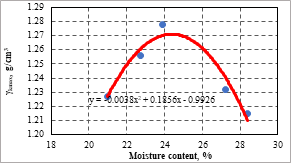
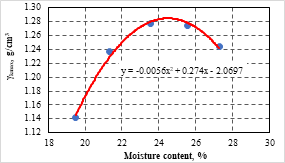
The results of my research have been highly encouraging. Chemically, the bottom ash proved to be environmentally safe; concentrations of toxic metals like Lead (Pb), Mercury (Hg), and Cadmium (Cd) were either non-detectable or significantly below safety thresholds. Physically, the material is classified as well-graded sand (SW). While it possesses a relatively high void ratio (1.521 to 2.313) due to its porous structure, it exhibits excellent compact ability. It achieves a maximum dry density of 1.274 ÷ 1.282 g/cm³ at an optimal moisture content of approximately 24.4% ÷ 24.5%. These findings confirm that MSWI bottom ash has significant potential as a sustainable alternative embankment fill material, contributing to both waste management and natural resource conservation.
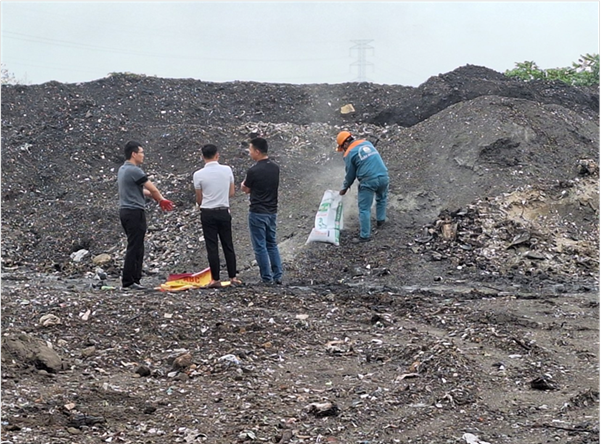
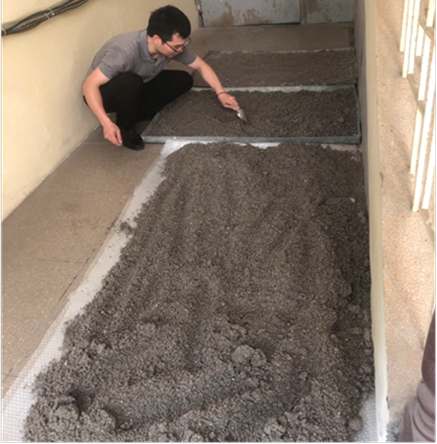
Fig. 1. Collection and natural drying process of MSWI bottom ash samples at the Geotechnical Laboratory
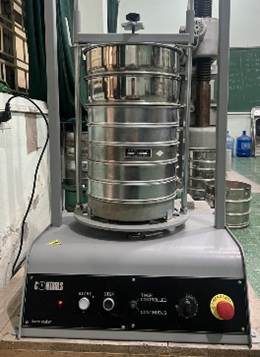
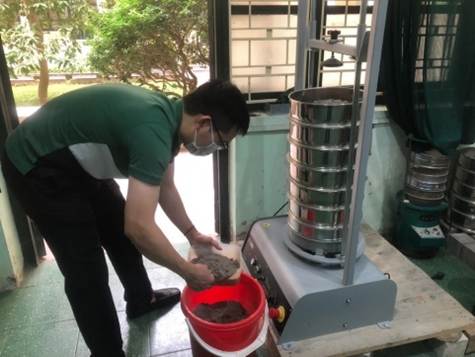
Fig. 2. Grain size distribution test / Particle size analysis experiment
 |
 |
| (a) | (b) |
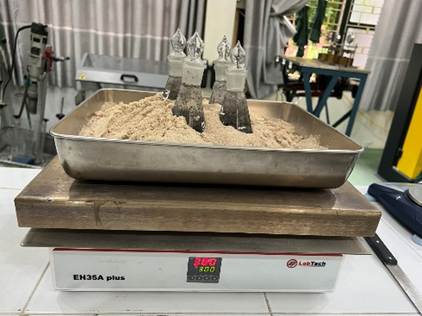
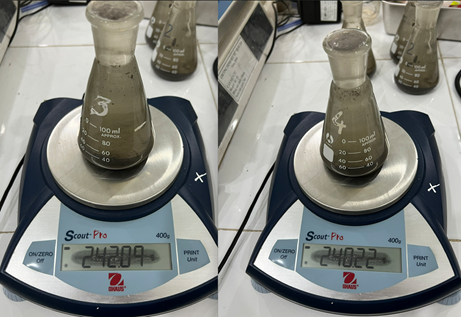
| Fig. 3. Conducting specific gravity test of soil particles: a) Heating process to remove entrapped air from the sample; b) Weighing the sample after cooling to room temperature | |
 |
 |
| (a) | (b) |
| Fig. 4. Correlation between moisture content and dry unit weight of bottom ash from waste incineration plants: a) Bottom ash sample from Hai Phong; b) Bottom ash sample from Hanoi | |
| << Previous | Newsletter Top | Next >> |