
Newsletter Volume 11, Issue 3 September 2026
Young Members
Understanding Screw Pile Performance and Installation Mechanisms: From Ground Disturbance to Soil Strength Evolution
Understanding Screw Pile Performance and Installation Mechanisms: From Ground Disturbance to Soil Strength Evolution
Ahmed Shekh Istiaq
PhD Student, Department of Civil and Environmental Engineering
Saitama University
PhD Student, Department of Civil and Environmental Engineering
Saitama University
 I am Ahmed Shekh Istiaq from Bangladesh. I completed my Master of Engineering in Civil and Environmental Engineering at Saitama University in 2022 and earned my Bachelor of Science in Civil Engineering from Khulna University of Engineering and Technology (KUET), Bangladesh, in 2012. I am currently pursuing a PhD in the Department of Civil and Environmental Engineering at Saitama University. Following my undergraduate studies, I joined the Bangladesh Water Development Board (BWDB), the leading government organization responsible for water resources management and hydraulic infrastructure development in Bangladesh. Over the years, I progressed from Assistant Engineer to Executive Engineer, where I have been involved in the planning, design, and implementation of flood embankments, revetment works, hydraulic structures, and other critical infrastructure projects. These responsibilities have required a thorough understanding of structural performance, failure mechanisms, and resilient engineering design. Bangladesh's soft ground conditions and seismic vulnerability present significant geotechnical challenges in infrastructure development. My professional experience with foundation design and ground improvement motivated me to pursue advanced research in geotechnical engineering, aiming to contribute to safer and more resilient infrastructure.
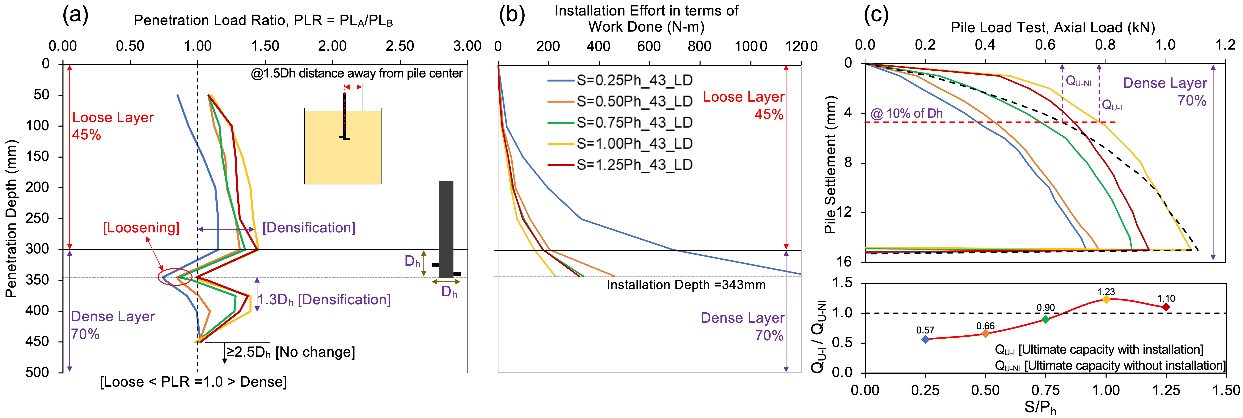
During my master's program, I conducted research titled “Effect of Penetration-to-Helix Pitch Ratio on Ground Disturbance and Bearing Response of Screw Piles in Bearing Layer.” The penetration (S) to helix pitch (Ph) ratio (S/Ph) per unit rotation affects screw pile performance. However, previous studies have reported inconsistent findings regarding the optimum S/Ph ratio under different soil conditions. To address this gap, my study focused on the effect of the S/Ph ratio on surrounding ground disturbance, installation effort, and bearing resistance when the helix is embedded in the bearing layer. My research concluded that during screw pile penetration, the ground around the helix undergoes loosening or densification due to the rotational effect, and this change depends on the initial state of the ground and the S/Ph ratio. In contrast, the surrounding ground below the helix undergoes densification due to the pressing effect and the S/Ph ratio. Overall, S/Ph=1.00 showed better performance because the soil moves along the helix slope face, resulting in lower ground resistance to penetration, negligible loosening in the bearing layer, and higher densification below the helix.
 |
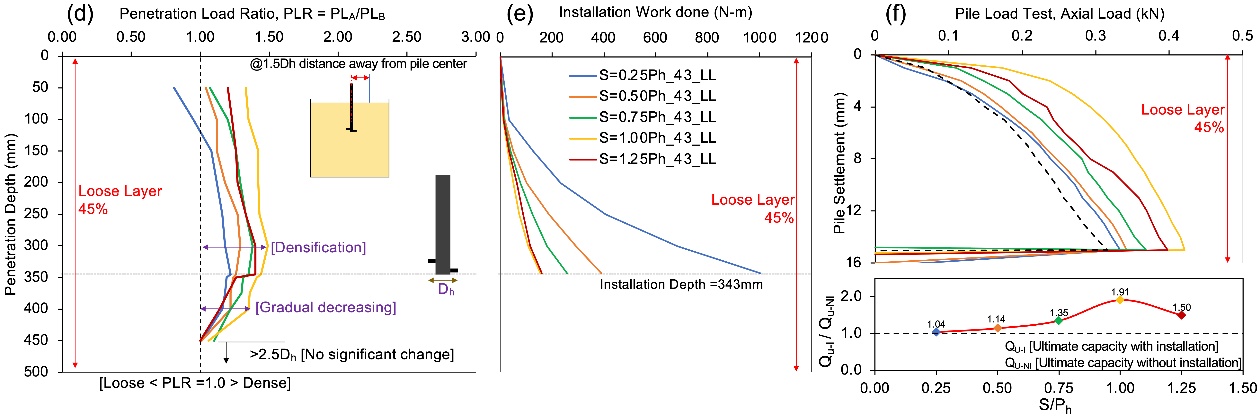 |
| Fig. 1 Surrounding ground condition, variation in installation effort, load-settlement response and ultimate bearing capacity with respect to S/Ph ratio (a, b, c: two-layers, loose over dense sand), (d, e, f: single-layer, loose sand) |
My current doctoral research aims to develop a mechanics-based understanding of screw pile installation effects by investigating how soil strength evolves along the stress path during installation. The study combines advanced laboratory testing with direct visualization techniques to capture soil disturbance patterns and quantify changes in soil behavior caused by rotational pile installation.
By linking installation-induced stress paths to changes in soil strength and deformation characteristics, this research aims to develop a comprehensive theoretical framework for screw pile behavior. The outcomes are expected to advance both fundamental soil mechanics and practical foundation engineering, ultimately providing a more rational basis for the design and analysis of screw pile foundations in complex ground conditions.
| << Previous | Newsletter Top | Next >> |