
Newsletter Volume 11, Issue 3 September 2026
From interface to installation mechanics: soil–pile interaction in press-in piles based on laboratory tests
School of Engineering – University of Sao Paulo
Abstract
1. Introduction
Soil-pile interface behavior plays a fundamental role in the performance of deep foundations, particularly in press-in piles, where load transfer is governed by shear stresses mobilized along the pile shaft. In these systems, the installation process directly controls the stress state and the evolution of resistance at the interface. Despite its importance, interface strength is often represented through simplified relationships, typically expressed as a constant ratio between the interface friction angle (δ) and the internal friction angle of the soil (φ). Such simplifications do not capture the complexity of the physical processes governing soil-pile interaction, nor do they account for installation effects. Early studies established that interface resistance depends on both soil properties and surface characteristics. Potyondy (1961) showed that friction between soils and structural materials varies significantly with interface conditions, while Brumund and Leonards (1973) demonstrated the importance of surface roughness, although interface strength remains bounded by soil shear strength. A significant advance was provided by Uesugi, Kishida and Uchikawa (1990), who introduced the concept of normalized roughness and demonstrated that interface strength increases with roughness up to a critical level, beyond which failure shifts from the interface to the soil mass. This established that interface behavior depends on the relative scale between surface features and particle size. Subsequent studies refined experimental approaches and their engineering interpretation. Paikowsky et al. (1995) developed dedicated interface testing devices, while Reddy et al. (2000) demonstrated the applicability of interface tests to pile shaft capacity. Gómez et al. (2008) extended the analysis to large displacements and complex loading paths. More recent work has emphasized micromechanical processes. DeJong and Westgate (2009) showed that interface behavior is governed by particle rearrangement, interlocking and confinement, while Martinez and Frost (2017) demonstrated that the form of surface irregularities is as important as their amplitude. Tehrani et al. (2016) further showed that increased shaft roughness leads to higher resistance and modifies the surrounding deformation field.
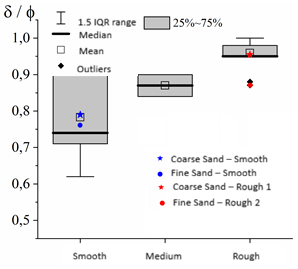
Within this context, the results presented by Nardelli et al. (2018) provide a quantitative basis for interpreting interface behavior in soil-pile systems. The statistical analysis of the δ / φ ratio (see Fig. 1) shows a clear increase in interface resistance with surface roughness, with median values evolving from approximately 0.74 for smooth surfaces to values close to unity for rough interfaces. This trend reflects the progressive mobilization of interlocking mechanisms and the transition from interface-controlled to soil-controlled failure.
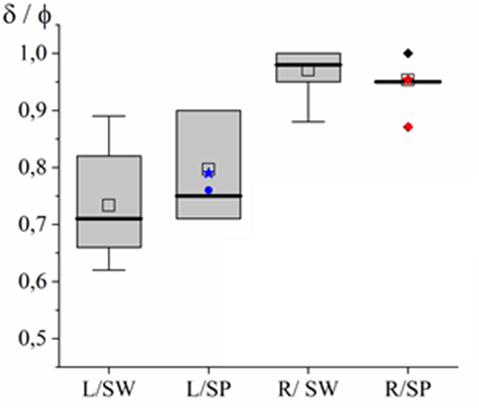
In addition, the influence of soil characteristics is reflected in the dispersion of results, as illustrated by the relationship between soil gradation and interface resistance (Fig. 2). Although median values remain relatively close, the variability highlights the role of micromechanical processes such as particle rearrangement and local interlocking.
These findings suggest that interface behavior is governed by multiple interacting mechanisms and evolves with stress conditions, rather than being defined by a single constant parameter. However, this understanding has not yet been fully integrated into a unified framework for pile installation, which motivates the present study.
 |
 |
|
| Fig. 1. Influence of surface roughness on the sand–concrete interface resistance under dry conditions (Nardelli et al., 2018). |
Fig. 2. Influence of sand gradation on the sand–concrete interface resistance under dry conditions. (Nardelli et al., 2018). L = Smooth, R = Rough, SW = Well graded sand, SP = Poorly graded sand |
2. Conceptual framework and methodological formulation
The framework proposed in this study is based on the interpretation that soil-pile interface behavior evolves as a function of confinement and surface characteristics, rather than being governed by a constant parameter. Press-in pile installation induces progressive soil displacement, leading to an increase in radial effective stress along the shaft. This process creates CNS-like conditions, in which the normal stress acting on the interface increases during shear. As a result, interface resistance develops progressively throughout installation. The statistical distribution of interface strength reported by Nardelli et al. (2018) supports this interpretation. The increase in δ / φ with surface roughness (Fig. 1) reflects the progressive mobilization of interlocking and confinement mechanisms, indicating that resistance develops continuously rather than being instantaneously mobilized. Furthermore, the variability observed in the dataset, particularly in relation to soil gradation (Fig. 2), demonstrates that interface behavior is governed not only by surface roughness but also by grain-scale interactions, which influence particle rearrangement and interlocking mechanisms.
3. Validation and consistency with experimental evidence
The proposed framework is based on experimental observations and statistical trends reported in the literature. The results compiled by Nardelli et al. (2018) demonstrate that interface strength increases systematically with surface roughness, as shown in Fig. 1. The transition from smooth to rough surfaces leads to a progressive increase in δ / φ , reaching values close to unity when failure shifts from the interface to the soil mass. Fig. 2 highlights the influence of soil gradation on interface behavior. While median values of δ / φ remain relatively similar, the dispersion of results reflects the variability associated with particle arrangement and interlocking mechanisms. These observations support the interpretation that interface behavior is governed by a combination of confinement, surface geometry, and micromechanical processes. When interpreted in the context of press-in piles, these mechanisms explain the high shaft resistance observed in practice because of increasing confinement and progressive mobilization of interface resistance during installation.
4. Conclusions
The proposed framework provides a consistent interpretation of soil-pile interaction in press-in piles. By recognizing that interface strength evolves during installation, it becomes possible to explain observed behavior without relying on empirical adjustments. The statistical trends indicate that interface resistance increases with surface roughness and may approach soil strength under conditions of high roughness and confinement. At the same time, the variability associated with grain characteristics highlights the importance of micromechanical processes. The distinction between roughness and waviness suggests that pile performance can be influenced by surface geometry, opening possibilities for optimization. In addition, surface transformation mechanisms imply that interface properties evolve with displacement and stress history, with implications for cyclic and long-term behavior. This study proposes a unified framework linking soil-pile interface mechanics to press-in pile installation. Interface strength evolves with confinement and surface characteristics:
- Press-in installation induces CNS-like conditions
- Surface geometry and transformation control interface behavior
- Interface resistance may approach soil strength under high confinement
- Design should incorporate installation effects
References
Brumund, W.F., Leonards, G.A., 1973. Experimental study of static and dynamic friction between sand and typical construction materials. Journal of Testing and Evaluation 1(2), 162–165.
DeJong, J.T., Westgate, Z.J., 2009. Role of initial state, material properties, and confinement condition on local and global soil–structure interface behavior. Journal of Geotechnical and Geoenvironmental Engineering 135(11), 1646–1660.
Gavin, K., Lehane, B.M., 2003. The shaft capacity of pipe piles in sand. Canadian Geotechnical Journal 40(1), 36–45.
Gómez, J.E., Filz, G.M., Dove, J.E., 2008. Sand–concrete interface behavior under complex loading conditions. Geotechnical Testing Journal 31(3), 1–10.
Lehane, B.M., Jardine, R.J., Bond, A.J., Frank, R., 1993. Mechanisms of shaft friction in sand from instrumented pile tests. Journal of Geotechnical Engineering 119(1), 19–35.
Lim, J.K., Lehane, B.M., 2015. Characterisation of the effects of time on the shaft capacity of jacked piles in sand. Géotechnique 65(10), 847–857.
Martinez, A., Frost, J.D., 2017. The influence of surface roughness form on interface strength. Géotechnique Letters 7(1), 1–6.
Nardelli, A., Cacciari, P.P., Futai, M.M., 2018. Sand–concrete interface resistance. In: Proceedings of the XIX Brazilian Conference on Soil Mechanics and Geotechnical Engineering (COBRAMSEG), Salvador, Brazil. [in Portuguese]
Nardelli, A., Cacciari, P.P., Futai, M.M., 2019. Sand–concrete interface response: The role of surface texture and confinement conditions. Soils and Foundations 59(5), 1675–1694.
Paikowsky, S.G., Player, C.M., Connors, P.J., 1995. A dual interface apparatus for testing unrestricted friction of soil along solid surfaces. Geotechnical Testing Journal 18(2), 168–193.
Potyondy, J.G., 1961. Skin friction between various soils and construction materials. Géotechnique 11(4), 339–353.
Reddy, E.S., Chapman, D.N., Sastry, V.V.R.N., 2000. Direct shear interface test for shaft capacity of piles in sand. Geotechnical Testing Journal 23(2), 199–205.
Tehrani, F.S., Prezzi, M., Salgado, R., 2016. Effect of shaft roughness on axial capacity of non-displacement piles in sand. Géotechnique 66(5), 386–400.
Uesugi, M., Kishida, H., Uchikawa, Y., 1990. Friction between dry sand and concrete under monotonic and repeated loading. Soils and Foundations 30(1), 115–128.
White, D.J., Bolton, M.D., 2002. Friction fatigue on displacement piles in sand. Géotechnique 52(6), 403–413.
| << Previous | Newsletter Top | Next >> |