
Newsletter Volume 11, Issue 2 June 2026
IPA Awards: Advancing Press-in Engineering – Voices from the 2024 Distinguished Research Award Recipients
IPA Awards Committee
Research Spotlight:
Deflection and failure of high-stiffness cantilever retaining wall embedded in soft rockInternational Journal of Physical Modelling in Geotechnics, Vol. 21, Issue 3, pp. 114–134, May 2021
https://doi.org/10.1680/jphmg.19.00008
Series Introduction — Why Distinguished Research Matters
This featured research exemplifies the series’ mission to advance innovation in press-in engineering. In this issue, we spotlight a study that investigates the deformation and failure behaviour of high-stiffness cantilever retaining walls embedded in soft rock.
Across rapidly urbanizing regions and heritage‑sensitive city cores, the promise of press‑in engineering lies in precision, low disturbance, and design agility. The IPA Distinguished Research Awards program recognizes research that significantly contributes to the advancement of press-in engineering, as documented in peer-reviewed publications. This series highlights award-winning research shaping the future of press-in engineering, focusing on practical innovation and personal perspectives from award recipients.
Research Overview (summary)
Authors:Vijayakanthan Kunasegaram (Tokyo Institute of Technology), Jiro Takemura (Tokyo Institute of Technology)
Study Scope and Approach:
This study presents a centrifuge modeling investigation of cantilever‑type steel tubular pipe (CSTP) retaining walls embedded in soft rock, with a particular focus on their behaviour from service conditions to ultimate failure.A key feature of the study is the development of an experimental approach that enables continuous simulation from excavation (design condition) to ultimate loading.
A newly developed testing system was used to reproduce the construction sequence under a constant centrifugal acceleration of 50g:
- Excavation was simulated by controlled water drainage at the wall front
- Ultimate loading was applied by progressive water feeding behind the wall
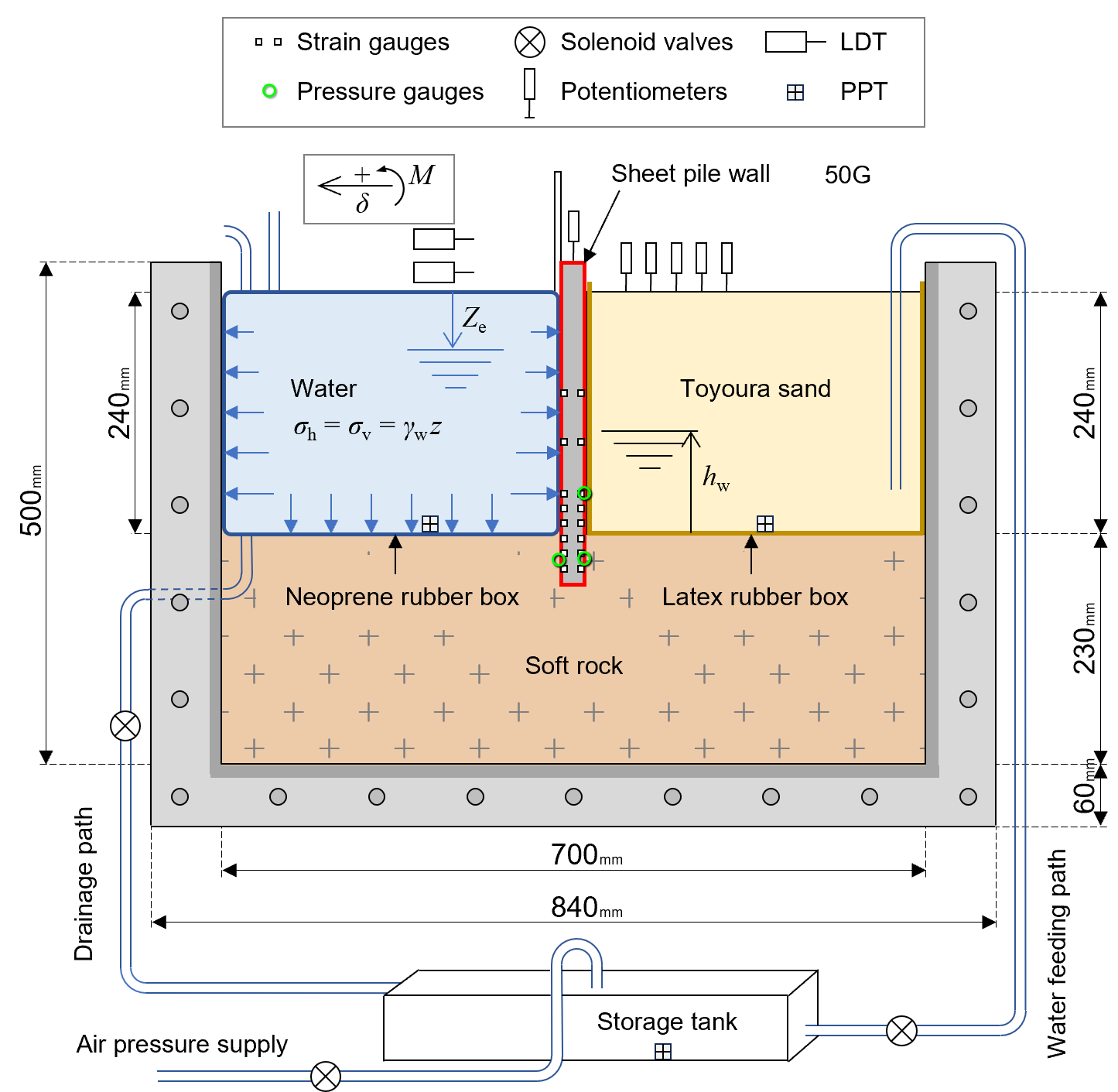
Fig. 1. Centrifuge model test set-up.
Adapted from Kunasegaram and Takemura (2021), International Journal of Physical Modelling in Geotechnics.
Key findings:
- Stable performance with relatively shallow embedment:
Under design (excavation-completed) conditions, wall-top displacement remained very small (approximately 0.2–0.3% of wall height), indicating stable behaviour even with relatively shallow embedment in soft rock.
- Transition in deformation mechanism:
Wall behaviour evolved from a combination of translation, rotation, and bending under service conditions to a rigid-body rotation mode as the loading level increased toward failure.
- Strong sensitivity to embedment depth:
A relatively small increase in embedment depth (approximately 20%) resulted in:
- Significant reduction in displacement
- Increased resistance at higher loading levels
- Transition of failure mode from brittle to more ductile behaviour
- Failure mechanism:
Failure was associated with compression in front of the wall and shear failure behind the wall toe, accompanied by rotation around a pivot point near the excavation base.
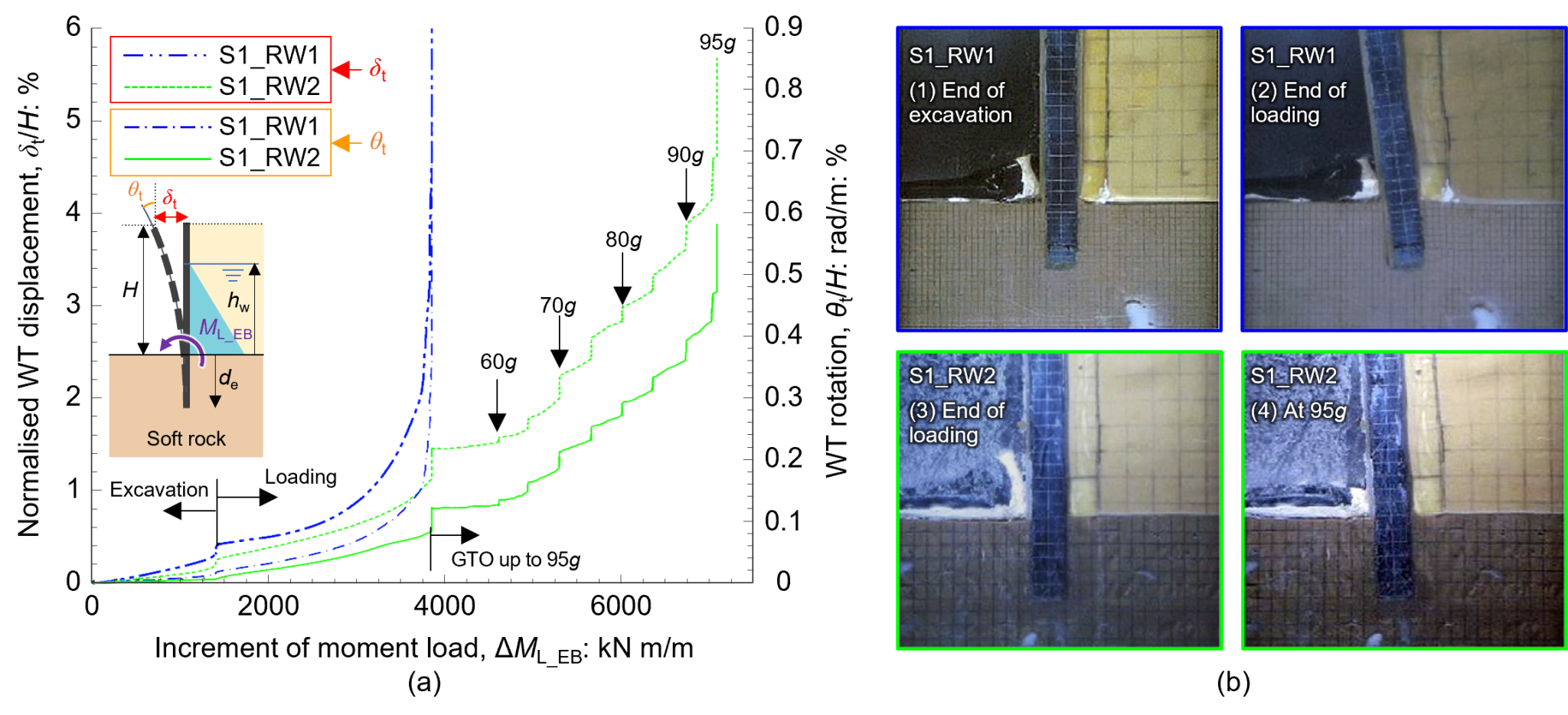
Fig. 2. Influence of embedment depth:
(a) normalised wall-top (WT) displacement and rotation plotted against applied moment;
(b) photographs of wall and ground deformation taken in flight after excavation and loading processes.
Adapted from Kunasegaram and Takemura (2021), International Journal of Physical Modelling in Geotechnics.
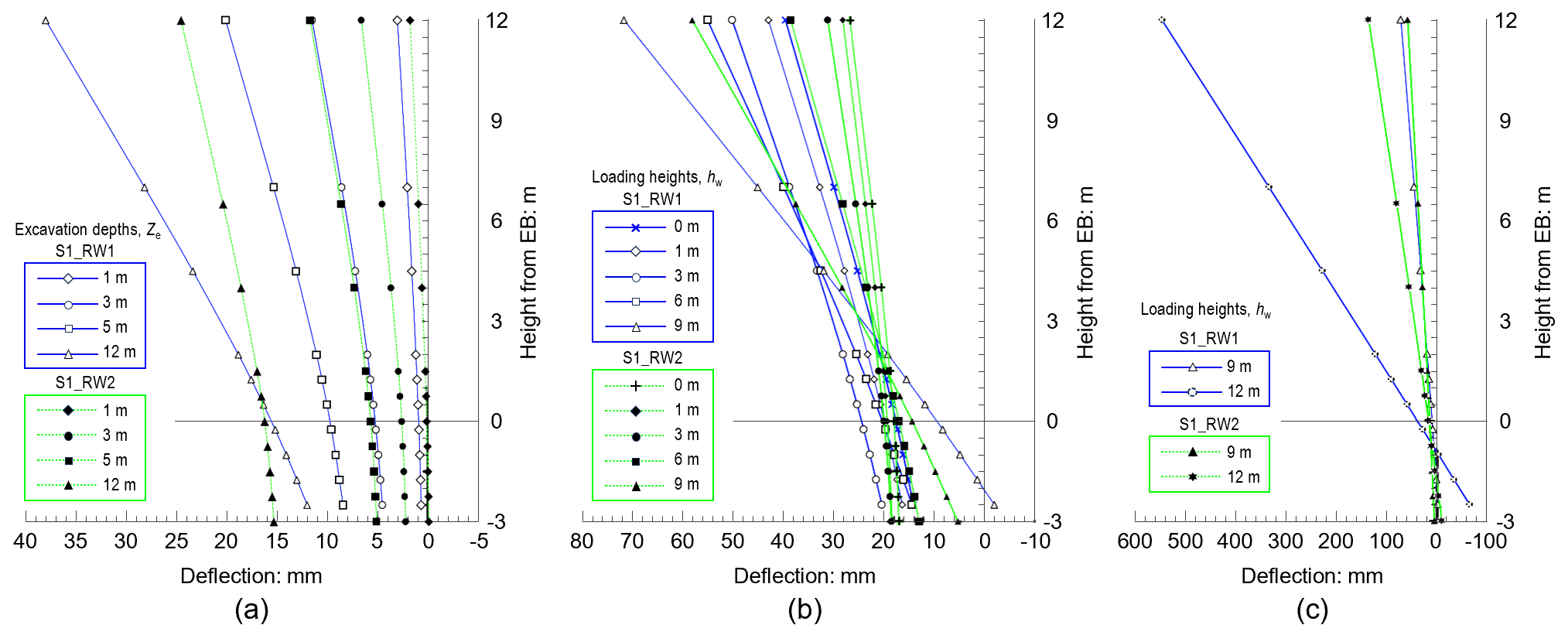
Fig. 3. Wall−deflection profiles during (a) excavation and (b, c) loading processes.
Adapted from Kunasegaram and Takemura (2021), International Journal of Physical Modelling in Geotechnics.
Significance & Impact for Press‑in Engineering
This study provides valuable insights for understanding and design of cantilever-type steel tubular pipe (CSTP) walls embedded in soft rock.
The key contributions demonstrated in this study can be summarised as follows:
- Embedment depth as a governing design parameter:
- Behaviour-based understanding of deformation mechanisms:
- Implications for conventional design approaches:
- Contribution to press-in engineering practice:
- Contribution to IPA Technical Committee 1 (TC1):
Further information on the activities of IPA Technical Committee 1 (TC1) can be found in the following reports:
- IPA Newsletter (Volume 6, Issue 1, March 2021)
https://www.press-in.org/_upload/files/Newsletter/Vol.6%2C1.pdf#page=15
- Takemura, J. (2021). State of the art report on application of cantilever type steel tubular pile wall embedded to stiff grounds, Proceedings of the 2nd International Conference on Press‑in Engineering (ICPE2021), available through the IPA Publications database (search by author name "Takemura” or the title of the report).
https://www.press-in.org/en/publication/index/2
Message from the Awardee (Corresponding Author)
Dr. Vijayakanthan Kunasegaram
Postdoctoral Research Fellow, The University of Western Australia
(Formerly Tokyo Institute of Technology)
I am sincerely grateful and honored to receive the 2024 Distinguished Research Award for our paper titled as “Deflection and failure of high-stiffness cantilever retaining wall embedded in soft rock”. Conventional design methods for cantilever steel tubular pipe (CSTP) walls are based on the theory of beams on elastic foundations, where the required embedment depth increases with the wall’s flexural rigidity regardless of retained earth height. This often leads to overly conservative designs and excessive steel pipe lengths, particularly for large-diameter CSTP walls. Therefore, optimizing embedment depth is essential for improving design efficiency and reducing construction costs. This study investigated the effects of embedment depth on the deformation behavior and failure mechanisms of CSTP walls embedded in hard ground conditions.
A centrifuge modelling system was developed to simulate the wall behavior in soft rock under a constant centrifugal acceleration of 50g, covering loading stages from design conditions to ultimate failure. The results showed that CSTP walls can maintain stability under design loads even with relatively shallow embedment depths, while still providing an adequate safety margin against failure. Under ultimate loading conditions, the walls exhibited rigid-body rotation about a pivot point. In addition, a modest increase in embedment depth, such as 20%, significantly improved wall stability. Observed failure mechanisms included compression failure in front of the wall and shear wedge failure behind the wall toe.
After the Award — Motivation, Career, and New Initiatives
The 2024 Distinguished Research Award presented for a study on the deflection and failure of high-stiffness cantilever retaining walls in soft rock, represents far more than a personal achievement; it reflects years of dedicated research, rigorous analysis, and extensive laboratory work in the field of geotechnical engineering. The study focused on understanding the interaction between high-stiffness structures and unpredictable soft rock formations, an area where uncertainty can lead to significant engineering risks. By identifying key deflection patterns and failure mechanisms, the research aimed to improve clarity and reliability in the design of CSTP walls.
This accomplishment was made possible through the collective efforts of co-author, laboratory technician, and the support of researchers from various institutions, whose expertise and commitment transformed complex concepts into meaningful outcomes. Gratitude is also extended to the Institute of Science Tokyo (former Tokyo Institute of Technology), funding organizations, and mentors who supported the research throughout its development.
The award provides strong motivation for future advancements and marks an important step toward translating research findings into practical engineering applications with the aid of advanced numerical modelling and validations. Future work will focus on collaborating with industry partners to incorporate the findings and numerical modelling outcomes into engineering design practices, improving the safety and cost-effectiveness of CSTP walls in the development of urban infrastructure. Thank you for this incredible honour. It sets a higher benchmark for our team, and we look forward to pushing the boundaries of rock mechanics and civil engineering even further.
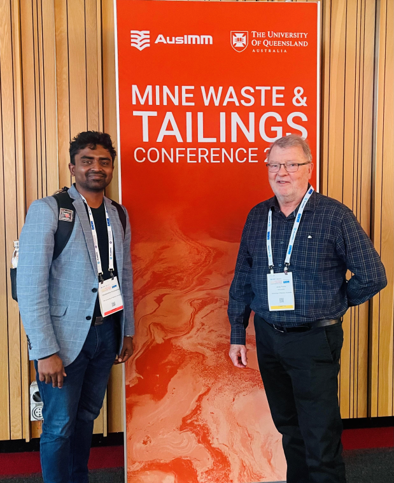
Photo 1. Dr. Vijayakanthan Kunasegaram (left) with Winthrop Professor Andy Fourie (right) during MWT-2025 (Brisbane, July 2025).
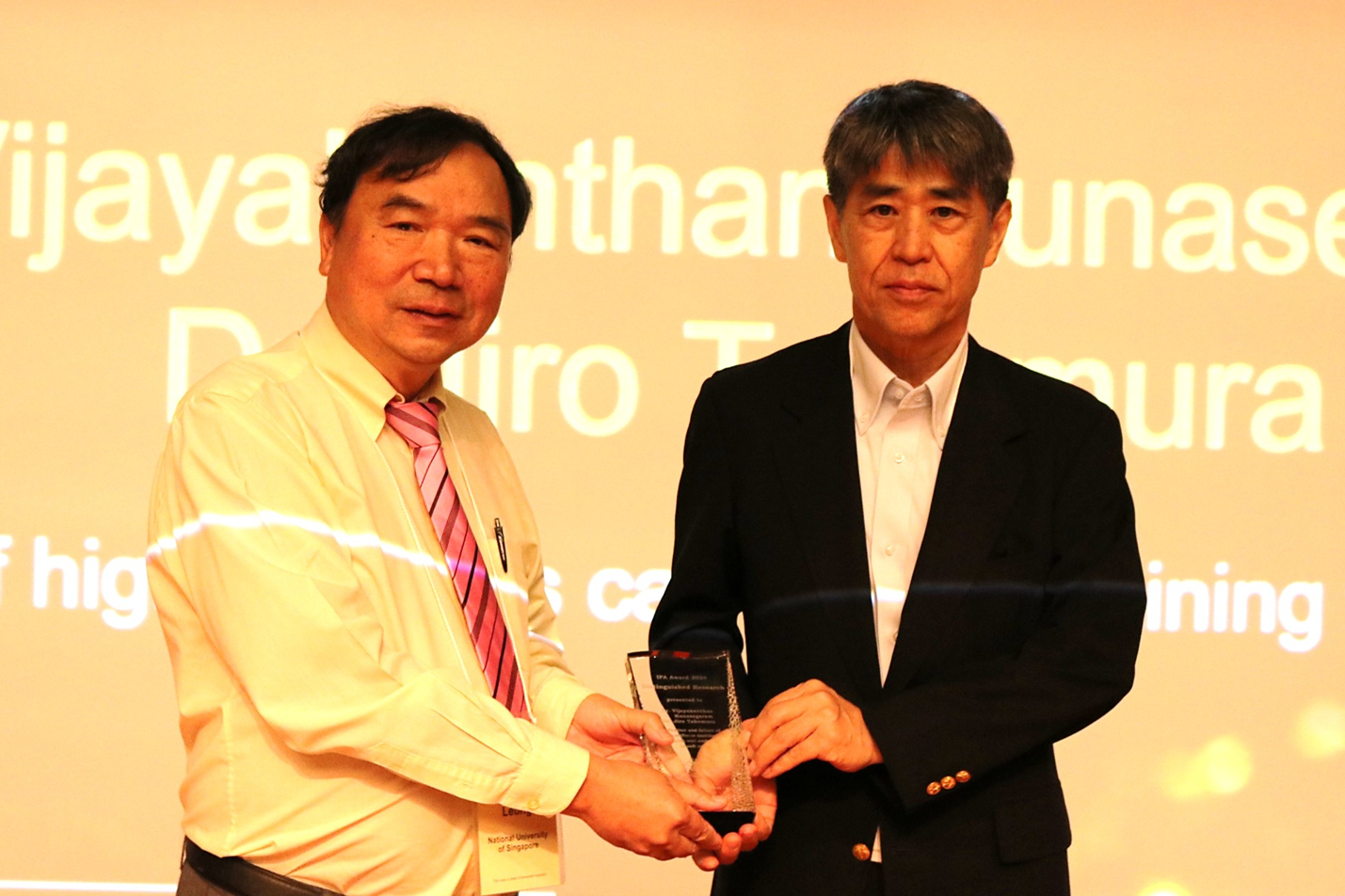
Photo 2. Professor Jiro Takemura, co-author (right, Institute of Science, Tokyo), receives the IPA Distinguished Research Award on behalf of Dr. Kunasegaram from Professor Chun Fai Leung (President of IPA at the time) during the ICPE2024 award ceremony (Singapore, July 2024).
Image Credits: Figures redrawn from Kunasegaram and Takemura (2021), International Journal of Physical Modelling in Geotechnics. Used with author approval.
Further Information
Looking ahead, the IPA Awards will continue to recognize outstanding contributions to press-in engineering at the 4th International Conference on Press-in Engineering (ICPE2027), providing a global platform to showcase innovative research, technologies, and practical achievements.
Further information on the IPA Awards at ICPE2027, including award categories and application details, is available on the official conference website:
https://2027.icpe-ipa.org/award/
- Complete list of recipients: https://www.press-in.org/en/page/distinguished_research_list
- Distinguished Research Award details and nomination form: https://www.press-in.org/en/page/distinguished_research
- Contact: ipa.award@press-in.org